The Ibà Valley takes its name from the river that runs through it and that, before arriving at the sea, changes its name to the Rio Torsero.
Set between Mount Pesalto and the hills of Ceriale and nearby Balestrino, it stretches for about 6 kilometers.
The Ibà Valley reaches a wonderful panoramic point at 716 meters above sea level, Poggio Ceresa.
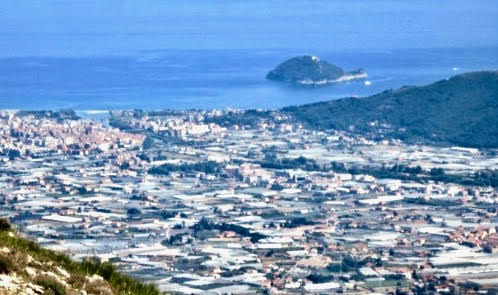
From there it dominates the plain of Albenga, the agglomerations of Cisano Sul Neva, Conscente and Salea and the vastness of the sea with our little jewel: the Gallinara Island.On particularly clear days, from this panoramic point of the Valle ibà, it’s possible to see Corsica (France).
Looking towards the North, from the Ibà Valley the view goes from the Ligurian Alps to Pizzo d'Ormea, Monte Carmo, Rocca Barbena and Monte Galero.
Not far from the start of the trail there’s a detailed miniature reconstruction that depicts the anthropological peculiarities typical of the Ibà Valley.
An example of a dry stone wall, one of stone box, an ancient shelter characteristic for men and livestock, and one of charcoal burner. Continuing along the path you can still see the traces.
The whole area is characterized by geological and morphological situations of great importance and value.
Pliocene marine terraces, evidence of the ancient presence of the sea in that area, limestone formations, breccias, clasts, dolomites, flints, and other rocky and sedimentary formations meet along the way.
They are easily identifiable thanks to the panels that invite you to make a STOP.
Furthermore, other panels in the shape of animals indicate the fauna of the Valle Ibà.Roe deer, fallow deer, lizards, hedgehogs, foxes, wild boar and “ocellated lizard”.
The “ocellata lizard”, which is very rarely seen, is a typical example of western Liguria (and some areas of Spain).
Other panels indicate the rich flora of the Ibà Valley.Among others, the white cistus and the blue one, different species of orchids, the broom, the navel of Venus, the juniper, the chestnut, the endemic blue Campanula of Savona and, although not marked by the signs, marked by the signs, the greasy grass of Reichembach (Pinguicola Longifolia).
The latter is a rare carnivorous plant that is found in few parts of Italy. In Liguria it is exclusively in Rocca Barbena and in Valle Ibà.
The walk in Valle Ibà is a precious naturalistic destination to relax in the green.It is highly recommended to everyone in every season, even more in autumn and winter, when it is covered in very warm colors.